


Video Overview
Identify air handling unit components and understand how they operate within larger HVAC systems in commercial properties.
An air handling unit (AHU) conditions and circulates air throughout commercial buildings as part of a larger HVAC system. The video reviews a heating and cooling AHU at a commercial large recreational facility with 21 AHUs. Facilities of this scale typically maintain dedicated facility management or engineering staff to monitor these systems daily.
Understanding the key components within an AHU, including filter arrays, heating and cooling coils, condensate management systems, and safety features, helps inspectors accurately identify observed components and document them in the inspection report as an inventory for their client. For properties with extensive AHU systems, or when clients request a detailed functionality and condition assessment, inspectors should consider involving a specialty HVAC consultant.
Check out our self-paced Inspecting Commercial HVAC Systems Online Course to learn more.
Key Components
The AHU unit shown in the video at contains both heating and cooling capabilities, with air entering one side and being distributed out the other to Variable Air Volume (VAV) boxes throughout the building.
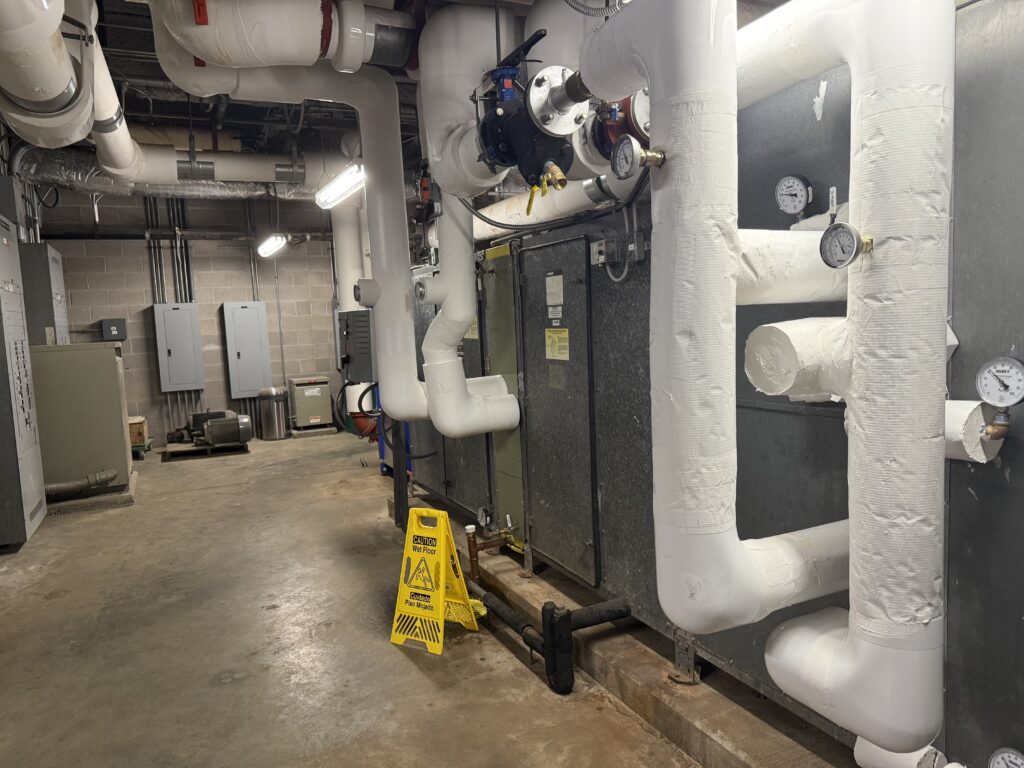
Air handling unit (AHU)
Heating and Cooling Coils
The AHU unit contains two separate coil systems positioned on opposite sides. Boiler piping leads to a coil inside the unit that receives hot water from the boiler and transfers heat to the air for heating, while piping on the opposite side connects to the chiller units and distribution pumps, bringing chilled water through the cooling coil for cooling.
A secondary filter system is installed just before the cooling coils for additional protection. Inspectors should note that condensate drains from the bottom of the cooling coil into the condensate management system described below.
Fresh Air Intake
AHUs require access to fresh air from outside. They may be located in mechanical rooms, on rooftops, near exterior walls, or centrally within buildings. Fresh air can be drawn directly through intake louvers or supplied through ductwork from exterior air intakes. The facility shown in the video has a centrally located AHU that receives fresh air from a separate unit on the building exterior.
Filter System
As fresh air is drawn into the unit, it first passes through a primary filter array located behind the intake chamber. These filters remove dust, debris, and particulates from the incoming air before it reaches system components. Filter arrays typically include arrows indicating airflow direction, which inspectors should note during observation.
The unit shown also includes a secondary filter system installed just before the cooling coils, providing an additional stage of filtration to protect the coils from contamination.
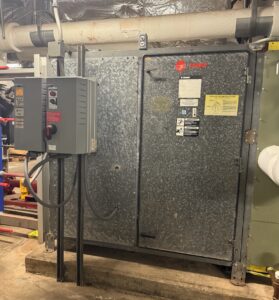
AHU access door to filters, fan, coils, and drain pan
Safety Note: Inspectors should never open compartments while a system is running or shut down HVAC systems during inspection. Inspection procedures should be limited to visual observation and noting component conditions, such as filter location and airflow direction indicators.
Condensation Management
As air passes over the cooling coils, condensation forms and drips into a condensate drain pan positioned beneath the coils. Like all HVAC equipment with cooling coils, the AHU must have this pan to collect water produced during the cooling process.
The drain pan works in conjunction with a trap assembly to ensure proper drainage while maintaining system integrity. Without a trap, the airflow created by the unit can pull air backward through the drain line, potentially introducing odors into the air system and preventing proper drainage. The trap creates a water seal that blocks this reverse airflow while allowing condensate to drain into the floor drain.
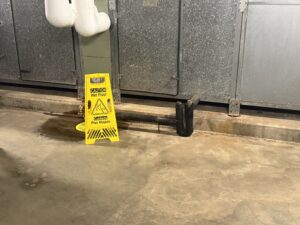
Condensate trap and drain line
Glycol Safety System
Some commercial facilities install supplemental freeze-protection systems on AHUs, such as glycol circulation loops or preheat coils. These systems are not standard on most AHUs and are typically found in cold climates or mission-critical buildings.
In the facility shown in the video, a secondary assembly operates independently of the primary cooling system and circulates glycol (antifreeze) through dedicated piping within the unit, using a plate-and-frame heat exchanger to transfer heating or cooling energy between the building water system and the glycol loop. The glycol’s lower freezing point helps protect the AHU from freeze damage during system failures in freezing conditions. Inspectors should note the presence of such systems when observed but avoid assuming they are present or required in other buildings.
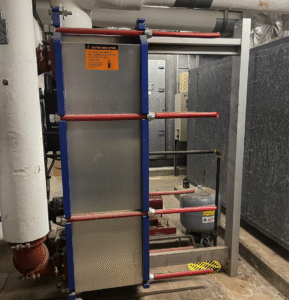
Heat exchanger transferring energy between the building water system and the AHU glycol loop
Inspector Takeaway
AHUs come in various configurations depending on building requirements and system design. Some provide only cooling or only heating, while others provide both. The unit shown in the video is a heating and cooling air handling unit that distributes air to Variable Air Volume (VAV) boxes throughout the building and uses hot water supplied by boilers for heating. AHUs operate as part of a larger HVAC system. Refer to the How Air Handling Units (AHU) Work video to see a cooling-only unit from this property.
Inspectors should carefully examine each unit to identify its specific components and configuration. Due to the complexity and variety of AHU designs, specialty consultation should be considered for large installations or when component identification is uncertain. For comprehensive training on commercial HVAC inspection procedures and common defects, refer to the Inspecting Commercial HVAC Systems Online Course.