


A critical safety aspect of interior exit stairways is visibility during an emergency. In terms of building design and life safety features, visibility is influenced primarily by illumination and smoke conditions. Continuous illumination is provided by emergency lighting and, in some cases, by safety-grade luminescent tape when the light fixtures don’t provide sufficient illumination, as determined by the AHJ.
Smoke control systems support ventilation and containment. The video above is from a high-rise building inspection, where smoke vents serve as a critical ventilation feature in the exit stairways. Note that fire and smoke dampers serve different purposes. Dampers are containment features installed where ducts pass through fire-resistive construction. In short, smoke vents release smoke to the exterior, while dampers close to contain and restrict smoke movement within the building.
To learn more about inspecting commercial interior exit stairways and life safety systems, take the self-paced Inspecting Commercial Fire and Life Safety Systems Online Course and earn your certificate upon completion.
Inspecting Smoke Vents
Smoke vents are typically roof-penetrating components. Inspectors commonly find smoke vents at the top interior exit stairways. Although smoke vents can be manually operated, they are primarily designed to automatically activate by a fusible link, a fire alarm system, or a combination of both, depending on the building design and level of system integration. Fusible links are heat-sensitive devices that activate a component when they melt.
During an inspection, document the location of smoke vents in the report as a fire and life safety component inventory. Look for visible obstructions or restraints that could hinder smoke vent operation and verify that vents are free of field modifications, such as zip ties or tape.
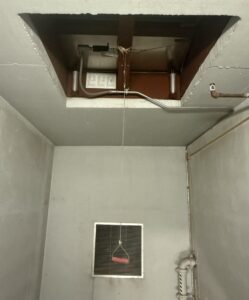
Double-leaf smoke vent
Understanding Smoke Control Systems
Fire and smoke dampers and smoke vents are just some of the key components of a smoke control system. The system also includes barriers (i.e., fire-rated walls, fire doors, smoke curtains), as well as detectors and control panels that connect to and activate these components. The objective of these components is to help maintain visibility and breathable air along egress paths.
Learn more by taking CCPIA’s Inspecting Commercial Fire and Life Safety Systems Online Course. This self-paced course covers how buildings are constructed to protect the structure and occupants, along with the key active and passive fire features identified during an inspection.