


Fire and life safety inspections focus on building features that reduce risk and protect occupants from fire and other hazards. This includes building design and construction, such as compartmentalization and means of egress, as well as active and passive protection features. Together, these design, construction, and special features provide layered protection for the building, occupants, and emergency response personnel. For a deeper look, take the self-paced Fire Door Inspection Online Course and earn your certificate upon completion.
The video above is an inspection of the top-story office suite in a high-rise building. It demonstrates how to use an evacuation map to identify and inspect the means of egress, plus inventory the fire and life safety features along it.
Using Emergency Evacuation Maps for Inspection Planning
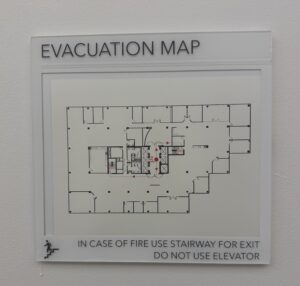
Emergency evacuation plans are AHJ-approved, code-compliant maps that illustrate exit paths and key fire and life safety features. A building may have several evacuation maps posted, either for the entire building or specific areas. Inspectors should check near the main entrance, exit doors, elevators, and alarm panels.
Since emergency evacuation plans indicate “You Are Here,” along with egress paths and key features, they serve as effective orientation tools for inspectors. Use the map during the preliminary walk-through, or before assessing the means of egress for a specific area in a large building, to plan the life safety inspection route.
Inspection Scope for Means of Egress
Commercial buildings should generally have two egress paths from the interior to the exterior at ground level. This provides an alternate route if one path is blocked or unsafe. Some codes allow a single exit when the maximum travel distance does not exceed 75 feet (22.86 m).
Within the baseline scope of the ComSOP, inspectors should confirm the presence of:
- At least two exits to the exterior, or
- One exit with a maximum travel distance of 75 feet.
When reviewing evacuation maps and planning the life safety inspection, also consider the following items included in the baseline scope:
- Fire alarm systems
- Smoke detectors and carbon monoxide detectors
- Portable fire extinguishers
- Sprinkler systems
- Exits signs and emergency lighting systems
- Directional signs where exits are not obvious
- Penetrations in fire-resistance-rated walls or ceilings
- Functional Fire doors and exit doors
- Trip hazards or conditions hindering safe egress
Elevators are not part of the means of egress. Compliant signage must be posted at or near the elevator bank stating, “In case of emergency, use stairs.”
Using Emergency Evacuation Maps During the Inspection
Take a photo of the map and use it to walk the designated exit routes, verifying the fire and life safety features within scope.
Although there’s no universal standard, these maps typically use symbols and colors to identify key features, such as:
- Arrows for primary and secondary exit paths
- Icons (often red) for fire protection equipment
- Lines to represent walls and structural layout
- Door symbols to indicate fire doors and corridor separations
Some maps may only show basic information, such as exit paths and limited fire protection features. When more detail is needed, consider requesting life safety drawings from the client. Life safety drawings typically include more information about fire-rated materials and fire door locations.
Directional signage is often an overlooked but important safety feature. As you walk the egress routes, ask:
- Are exit signs clearly guiding occupants out of the building?
- Are there areas where the path of egress is unclear?
- Are additional directional signs needed?
Also consider whether the building reflects its intended final configuration. In buildings under renovation or with pending leases, future partitions and layout changes may impact egress routes and evacuation plans. Discuss this with your client ahead of time.
The video shows the inspector reviewing the evacuation map for the floor being inspected, then walking the means of egress while assessing exit signs and fire doors. Watch the video to follow along as key reportable defects are identified and to understand how fire doors function as a compartmentalization feature during a fire or smoke event.
CCPIA’s Inspecting Commercial Fire and Life Safety Systems Online Course covers the essential information for inspecting means of egress and fire and life safety features within the baseline scope. For a more focused review of fire doors, take the Fire Door Inspection Online Course.
TESTING SOMETHING
Additional Training Resources
CCPIA’s Inspecting Commercial Fire and Life Safety Systems Online Course covers the essential information for inspecting means of egress and fire and life safety features within the baseline scope. For a more focused review of fire doors, take the Fire Door Inspection Online Course.